Reviewed · SHOW
Ginga Tropical Show – Brazilian Rhythms
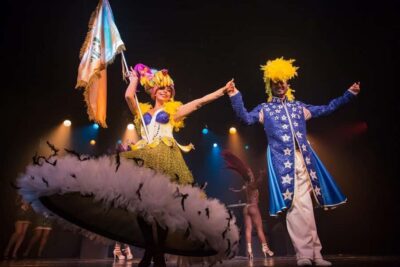
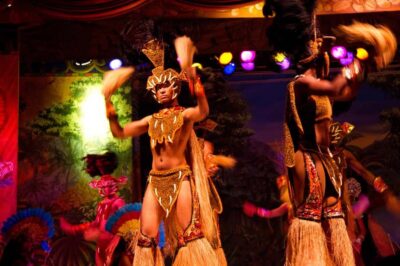
Brazil is far more than samba, and Ginga Tropical makes that clear in a fast-moving stage show covering dances from the Amazon, Bahia, Rio, the Pampas, and Brazil’s northeast. You’ll see capoeira, lambada, forró, frevo, carimbó, and samba, with live drumming and an invitation to dance at the end.
I like the wide cultural range, and I like the easy hotel pickup and drop-off when that option is selected. The main caution is organization: several bookings have suffered from unclear pickup details, seating problems, venue changes, or even cancellations, so reconfirm everything before leaving your hotel.
In This Review
- Key points to know
- A fast tour of Brazil through dance
- What happens from pickup to curtain call
- The regional program, section by section
- Why the live drumming and costumes matter
- Seating and venue problems you should take seriously
- Is the $97.82 price good value?
- Who will enjoy Ginga Tropical most
- Booking, timing, and small practical tips
- Should you book this Rio dance show?
- FAQ
- How long does the Ginga Tropical Show experience last?
- What dances are included in the performance?
- Is hotel pickup included?
- Can I book tickets without transportation?
- Is dinner included?
- What is the cancellation policy?
Key points to know
- Brazil beyond Carnival: The program includes carimbó, xaxado, forró, frevo, maculelê, capoeira, dances of the Orixás, boleadeiras, bossa nova, and samba de gafieira.
- Audience participation: The final portion can bring you onto the stage, and you may be taught simple samba movements.
- Live music and costumes: Drummers, singers, athletic capoeira performers, and striking Carnival outfits keep the show moving.
- Transfers save hassle: Hotel pickup and return are available for most hotels in Rio’s South Zone when that option is booked.
- Dinner needs checking: The advertised Brazilian barbecue upgrade has not always been available, especially after the show moved to a shopping mall theater.
- Plan for a late evening: Pickup may begin well before the 9:30 p.m. show, and the performance can end around 11 p.m.
A fast tour of Brazil through dance
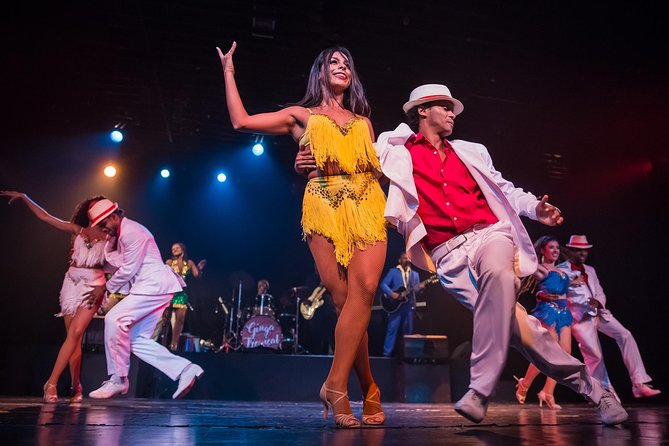
Ginga Tropical is best understood as a cultural sampler rather than a single samba performance. The production moves through many Brazilian regions and traditions, giving you a broad introduction in roughly an hour and a half of stage time, inside an overall outing of two to three hours.
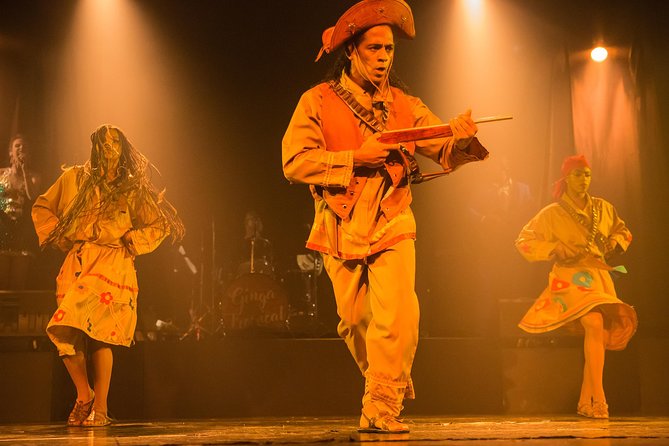
That range is the show’s strongest feature. You might begin with northern Brazilian traditions connected with the Parintins Festival and carimbó, then move toward the northeast with xaxado, forró, and frevo. Later sections bring in Bahia’s ritual dances, capoeira, Rio’s bossa nova and samba de gafieira, and the Carnival finale.
I like this format for a first visit to Brazil. If your only mental picture of Brazilian dance is a feathered Carnival costume and a samba parade, the show gives you a wider frame. You see how different rhythms, movements, instruments, and regional stories fit into one country.
The pace is quick. There is little time for long explanations between numbers, so the guide matters. Guides such as Luis have been praised for explaining what each section represents and helping the audience follow the shift from one region to another.
A few more Rio tours worth weighing up
- Rio: Ginga Tropical Samba and Folklore Show Ticket
★ 4.7 · 231 reviews - Ginga Tropical – Brazilian Samba and Folklore Show
★ 4.5 · 216 reviews - Rio de Janeiro: Samba Show Admission & Transfer
★ 3.7 · 24 reviews
What happens from pickup to curtain call
If you choose the transfer option, the evening begins with pickup at your Rio hotel. The service is aimed at most hotels in the South Zone, but the exact pickup time is determined after booking and reconfirmation.
Do not rely only on the first time shown during checkout. One booking may display an 8 p.m. start, while the final notice gives a 7:50 p.m. pickup. The show itself may not begin until about 9:30 p.m., and the vehicle can collect several parties before heading to the theater.
That matters because the ride can take close to an hour if you are among the first pickups. It is not wasted time if you prefer not to navigate an unfamiliar part of Rio at night, but you should not schedule a tight dinner reservation or another evening activity.
Drivers and guides can shape the experience. A well-run departure has included an attentive guide and a comfortable van ride, while another booking involved a late, cramped, and discourteous transfer. I would reconfirm the pickup location, phone contact, and expected time rather than assume the operator has every detail right.
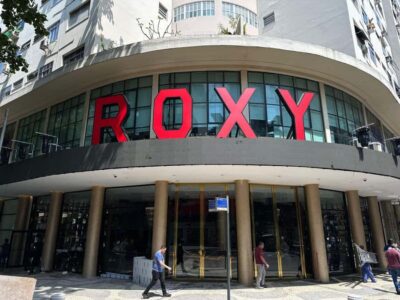
At the venue, your guide handles or directs ticket collection, depending on the option you bought. If you selected ticket only, go to the ticket office with the reservation name and voucher number. The supplied address is Centro Cultural Veneza, Avenida Pasteur, 184, Botafogo.
There is an important detail to verify here. The information also identifies the performance location as the Fashion Mall Theater, while the ticket-only directions give the Centro Cultural Veneza address. Because the venue has changed in the past, confirm the current address and meeting instructions before setting out.
The show closes with audience participation. Dancers may invite people onto the stage, and the audience may be shown basic samba steps. You can watch from your seat, but the final section works best if you are willing to stand up and join in.
The regional program, section by section
The opening sections introduce northern Brazil, including the Parintins Festival and carimbó. These numbers help set the tone: this is not simply a Carnival revue. Expect colorful movement, strong rhythms, and dance forms tied to local celebrations.
The northeastern sequence includes xaxado, forró, and frevo. Forró is commonly associated with social dancing, while frevo is known for quick, energetic footwork. On stage, these sections add variety after the larger festival scenes.
Lambada brings a more flirtatious, hip-driven style. It is one of the numbers most likely to feel instantly familiar to an international audience, even if you have never seen it performed live in Brazil.
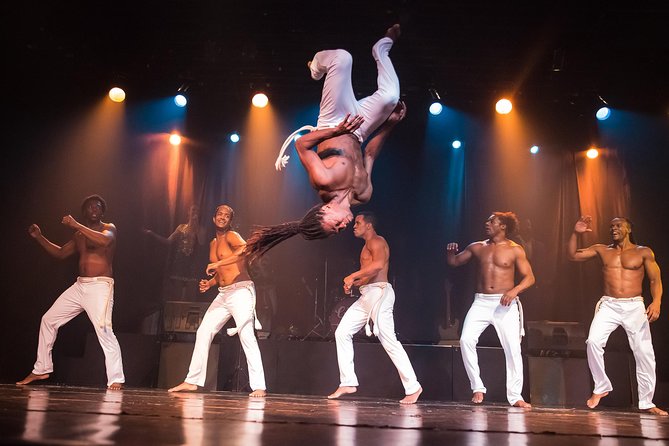
Capoeira changes the mood again. The athletic exchanges combine dance, music, and martial movement, and the show also includes maculelê, a performance tradition using sticks. These are among the most physical sections of the evening.
The Dance of the Orixás represents Afro-Brazilian religious and cultural traditions connected with Bahia. This section is valuable because it gives the performance a spiritual and ceremonial side, not just party energy. The treatment is necessarily brief, so think of it as an introduction rather than a full explanation of the traditions.
The program also reaches the southern Pampas with boleadeiras. This offers a striking contrast to Rio’s samba and the northeast’s quick footwork. The movement and props help show how regional dance can reflect local customs and working life.
Bossa nova brings a smoother, more restrained rhythm. It serves as a useful pause after capoeira and the faster regional dances, while connecting the show to Rio’s musical identity.
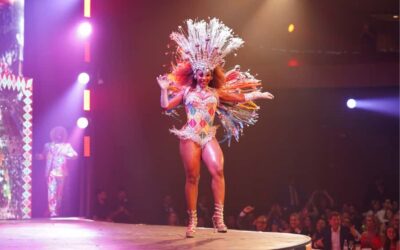
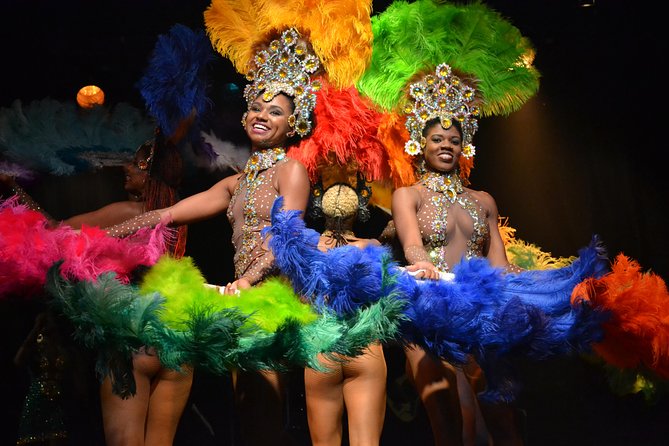
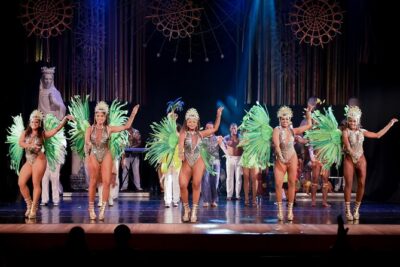
Samba de gafieira follows, then the better-known Carnival section. The final costumes, drums, and hip-shaking choreography deliver the large finish most people expect when they book a Brazilian dance show.
Why the live drumming and costumes matter
Recorded music could carry a stage production like this, but live drumming changes the feel. The percussion gives the dancers a strong pulse and makes the Carnival scenes feel closer to a social celebration than a formal theater recital.
Costumes do much of the visual storytelling. The show uses colorful and sometimes outrageous Carnival outfits, along with clothing suited to different regional numbers. You can often understand the mood of a scene before the guide explains it.
The cast’s energy has earned the strongest praise. The dancers perform continuously, and the combination of acrobatics, drumming, singing, and movement keeps the program from dragging. Large groups should note this: even people who arrive tired after a full day of sightseeing may find the pace easy to follow.
Still, the venue can limit the impact. The theater has been described as small, and some feedback points to weak acoustics and insufficient air conditioning. If you are sensitive to heat, noise, or crowded seating, keep those limitations in mind.
A different side of the city, same few days:
- Rio de Janeiro: 6-Stop Highlights of Rio with Lunch
★ 4.4 · 5,157 reviews - Christ the Redeemer Entry Ticket by Corcovado Train
★ 4.4 · 4,476 reviews - Rio de Janeiro: Rocinha Favela Walking Tour with Local Guide
★ 4.8 · 3,052 reviews - Rio: Christ the Redeemer, Sugarloaf, Selaron & BBQ Lunch
★ 4.5 · 2,428 reviews
Seating and venue problems you should take seriously
Most departures appear to run without trouble, but the organization has not been consistent. One serious incident involved overbooking, plastic chairs, people seated on steps, delays at the entrance, and staff struggling to manage the line.
That kind of problem is not a minor inconvenience. It can change a lively evening into a frustrating one, especially when the ticket price is close to $100 per person. The operator attributed that incident to an attraction error and said refunds were provided in some cases.
Another booking found the theater closed with no show and no useful communication. Other cancellations have also been reported, including a period when the tour was suspended because of operational problems. These incidents appear unusual compared with the many successful departures, but they are too serious to ignore.
My practical advice is simple: reconfirm the show and pickup shortly before the date, save the operator’s contact information, and avoid arriving at a venue whose location has not been confirmed. If you buy ticket only, be especially careful with the address and ticket collection procedure.
The maximum group size is 40 people. That is not an intimate private tour, but it is manageable when the theater and entrance process are functioning properly.
Is the $97.82 price good value?
At $97.82 per person, the experience is not a cheap night out. You are paying for a ticket, a guided cultural introduction, and, if selected, hotel transport. Food and drinks are not included in the standard price.
The value is strongest if you want a single evening that covers many Brazilian dance traditions without arranging separate performances or traveling to different neighborhoods. For a first visit to Rio, the broad program can help you decide which musical styles you want to explore in more depth.
The price is harder to justify if you only want samba. Samba appears late in the program, and much of the performance is devoted to regional forms such as forró, frevo, carimbó, and capoeira. That is a strength for curious visitors, but a mismatch for anyone expecting a nonstop Carnival spectacle.
Transfers add practical value. A return ride to a central South Zone hotel means you do not have to arrange late-night transport after the show. Some taxi rides across Rio can also become expensive, particularly if a booking problem forces you to make your own way across the city.
Be careful with the dinner upgrade. The advertised buffet may include barbecued meats, seafood, salads, local specialties, desserts, and drinks available for purchase. But the dinner has not always been offered, especially after the performance moved to a mall theater, and some bookings were sold with dinner even though no dinner was available.
If dinner is important to you, confirm it in writing before paying. If it is not available, ask for the correct price adjustment through the booking channel rather than assuming the meal will appear at the venue.
Who will enjoy Ginga Tropical most
I would recommend this show to you if you want a lively introduction to Brazil’s regional culture and prefer music, costumes, and movement to a seated lecture. Families with children aged six and older can participate, although younger children may find the late timing difficult.
It also suits groups. The audience interaction gives friends and relatives something to do together, and the final stage invitation can be a fun shared memory. You should be comfortable with the possibility of being invited to dance, though participation is not presented as a requirement.
This is less suitable if you need a polished theater setting, quiet seating, strong air conditioning, or a tightly controlled schedule. It is also not the right pick if your evening depends on a guaranteed dinner package or an exact pickup time.
The show is performed in English-supported tour settings, and guides have been praised for clear English explanations. The performance itself depends more on music and movement than language, so you can follow most of it even if you do not understand Portuguese.
Booking, timing, and small practical tips
Book ahead during busy periods. The experience is often reserved about 48 days before the date, and at least one booking reported that the show could sell out. A reservation made early is useful, but it does not replace reconfirmation.
Allow two to three hours for the whole outing. Pickup may be much earlier than the curtain time, the ride can be long with multiple hotel stops, and the show may finish around 11 p.m.
The minimum age is six. Most people can participate, but the venue and seating conditions may matter if you have mobility concerns or need a particular type of chair. The supplied information does not promise accessible seating, so ask before booking if that is important.
Free cancellation is available up to 24 hours before the experience begins. Cancellations or changes made inside that window are not accepted for a refund, and cut-off times use Rio’s local time.
If something goes wrong, contact both the booking platform and Gray Line Brazil promptly. Keep your voucher, reservation name, pickup details, and any messages. That paper trail may matter if the venue is closed, the transfer does not arrive, or dinner is missing from a package that included it.
Should you book this Rio dance show?
Yes, if you want breadth, energy, and audience participation. The strongest part of Ginga Tropical is the chance to see Brazil presented as many cultures and dance traditions, not just one Carnival number. The live drums, capoeira, costumes, and final invitation to dance give the night real momentum.
I would book the transfer option if it is clearly confirmed for your hotel. I would also verify the current theater address, show status, pickup time, and dinner availability before the evening.
Book it with realistic expectations: this is an entertaining cultural revue in a sometimes imperfect venue, not a grand theater production. If the logistics are confirmed, it can be a memorable introduction to Brazil. If you need flawless organization, guaranteed dinner, or a formal seating experience, choose another evening plan.
FAQ
How long does the Ginga Tropical Show experience last?
The full experience takes approximately two to three hours, including hotel pickup, transport, the performance, and return to your hotel. The show itself may begin around 9:30 p.m. and end near 11 p.m.
What dances are included in the performance?
The program includes samba, bossa nova, lambada, forró, frevo, carimbó, xaxado, maculelê, capoeira, the Dance of the Orixás, boleadeiras, samba de gafieira, and Carnival numbers.
Is hotel pickup included?
Hotel pickup and drop-off are included when that option is selected. The service covers most hotels in Rio’s South Zone, and the exact departure time is provided after reconfirmation.
Can I book tickets without transportation?
Yes. With the ticket-only option, collect your ticket from the ticket office using the reservation name and voucher number. Confirm the current venue address before going, since the theater location has changed.
Is dinner included?
Food and drinks are not included in the standard ticket. A Brazilian barbecue buffet upgrade is described, but its availability has varied, so confirm that dinner is operating before booking it as part of your evening.
What is the cancellation policy?
You can cancel up to 24 hours before the experience start time for a full refund. Changes or cancellations made less than 24 hours in advance are not accepted for a refund.
Just added around Rio
- Rocinha Jeep Tour: A Journey into the Soul of the Favela!★ 3.8 · 3 reviews
- Tijuca National Park and all its wonders!★ 5.0 · 3 reviews
- Rio: Best Dive Experience All Inclusive Scuba Diving Package★ 5.0 · 3 reviews
- Rio de Janeiro: Doors-off 30-min helicopter tour★ 5.0 · 3 reviews
- Rio de Janeiro: Hang gliding adventure★ 3.7 · 3 reviews
- Pedra Bonita Trail: The easiest trail with a beautiful view of Rio★ 4.6 · 3 reviews
- Rio de Janeiro Secluded Beaches: Hike+Swim Prainha & Grumari★ 5.0 · 3 reviews
- Unforgettable Boat Party★ 5.0 · 3 reviews
Show, compared.

Ginga Tropical – Brazilian Samba and Folklore Show
Read our review →