
Reviewed · SELARóN STEPS & SANTA TERESA
Walking tour of the bohemian neighborhoods of Santa Teresa and Lapa
The best part of this Rio tour is the yellow Bonde tram ride into Santa Teresa. It climbs through the hills for about 30 minutes, then leaves you in a neighborhood of old houses, artists, cafés, street art, and broad views over central Rio. From there, you walk downhill through Santa Teresa and Lapa, ending among the city’s grand civic buildings.
I like the mix of transport and walking, since you see Rio from the tram window and at street level. I also like the small-group limit of 12, plus the chance to have a guide such as Edmundo, Lorena, or Ivan explain the area with local insight. The main drawback is that the tram can be disrupted, and the tour is non-refundable, so this is not a good choice if your plans are uncertain.
In This Review
- Key points before you book
- Why Santa Teresa and Lapa work so well together
- The Bonde ride up Santa Teresa
- Largo dos Guimarães and the heart of Santa Teresa
- Parque das Ruínas and the wide Rio view
- Selarón Steps, Rio’s tiled public artwork
- Lapa Arches and the old aqueduct
- Cinelândia and central Rio’s grand buildings
- Guides who shape the experience
- What the $72.09 price covers
- Walking demands, group size, and timing
- Who should book this Rio walking tour?
- FAQ
- Where does the tour start?
- Where does the tour end?
- How long does the experience last?
- How large is the group?
- Is the Bonde tram ride included?
- What neighborhoods does the tour visit?
- Which major sights are included?
- Is the tour suitable for most people?
- Can I cancel or change the booking?
- Should you book it?
Key points before you book
- Ride the historic yellow Bonde tram: The 30-minute climb is the scenic gateway to Santa Teresa and one of the tour’s signature moments.
- Explore two very different districts: Santa Teresa brings old homes, art, and hilltop views, while Lapa adds murals, arches, nightlife history, and monumental buildings.
- See Rio from Parque das Ruínas: This former mansion site offers views toward the Centro, Lapa Arches, Christ the Redeemer, and Botafogo.
- Walk across Selarón Steps: The multicolored staircase is one of Rio’s most photographed public art sites.
- Benefit from a small group: The maximum of 12 people should make questions and route adjustments easier.
- Plan for a firm commitment: The experience costs $72.09 per person and cannot be changed or refunded after booking.
Why Santa Teresa and Lapa work so well together
Rio is often sold through its beaches and famous viewpoints, but Santa Teresa and Lapa show a different side of the city. Santa Teresa sits on a hill above central Rio, with winding streets, older architecture, studios, bars, and a slower feel. Lapa, lower down, is more urban and monumental, known for its arches, public squares, graffiti, and evening entertainment.
I like this route because it has a natural downhill flow. You begin with a ride, spend time wandering Santa Teresa, then descend toward Lapa and Cinelândia. The result is more varied than a simple neighborhood walk, though you should expect a proper walking tour rather than a ride-based sightseeing loop.
The tour lasts about three and a half hours and begins at 9 a.m. The stated meeting point is the Copacabana Palace on Avenida Atlântica, and the activity is listed as returning there at the end. Past arrangements have included meeting people at their hotels and using the metro to reach the tram, so confirm the exact pickup plan when you book.
More of Santa Teresa and the Selaron Steps:
- Rio: Christ the Redeemer, Sugarloaf, Selaron & BBQ Lunch
★ 4.5 · 2,428 reviews - Rio de Janeiro: Christ, Selaron Steps, and Tijuca Park Tour
★ 4.7 · 857 reviews - Santa Teresa, Lapa, and Cinelândia with Tram Ride and Selarón Steps
★ 4.5 · 274 reviews
The Bonde ride up Santa Teresa

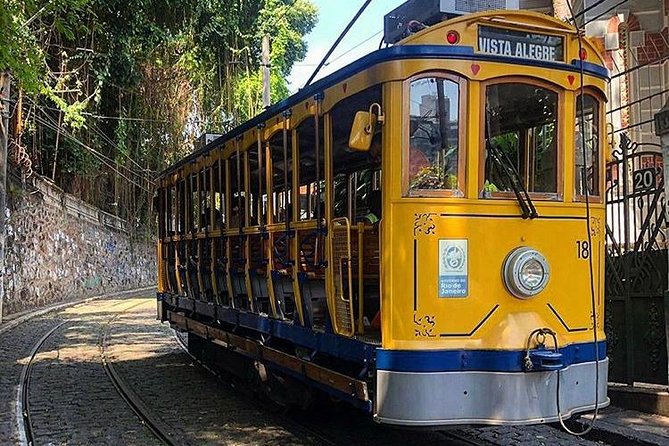
The tour starts at the Santa Teresa tram station, where you board the famous yellow Bonde. The tram climbs for roughly 30 minutes, giving you a moving view of Rio as the city rises toward the neighborhood.
This is not just a practical transfer. The tram is part of Santa Teresa’s identity, and the slow ascent sets the mood for the rest of the morning. You get time to look out, take photographs, and watch the city change from central streets to hillside homes.
The tram ride also gives the tour a sense of occasion that a taxi or van would miss. At the same time, it is the one part of the day most exposed to local operating conditions. A recent tour adjustment was needed when the streetcar could not run as planned because of a situation in the neighborhood. A good guide can adapt, but you should not treat the tram as a guaranteed standalone attraction.
Some tours have included metro tickets and tram tickets in the price. A caipirinha has also been included on at least one outing, although the tour details do not promise either a drink or a specific refreshment for every departure. Consider those pleasant extras, not part of the core value.
Largo dos Guimarães and the heart of Santa Teresa
At Largo dos Guimarães, you spend about 45 minutes walking around the center of Santa Teresa. This is where the district feels most social, with restaurants, bars, old homes, and streets that invite a slower pace.
The architecture is one of the main reasons to linger. The area includes houses dating from the late 19th and early 20th centuries, giving you a look at an older Rio that feels far removed from the beachfront districts. The guide can help connect the buildings, streets, and local artistic life rather than leaving you to see only a collection of pretty façades.
I would use this stop to ask questions. Guides such as Edmundo and Ivan have strong links to the neighborhood, and Ivan is a Santa Teresa native. Edmundo is also an artist and has personal connections around the district, while Lorena has been praised for combining information with candor and humor.
That local contact can change the experience. You may get more than dates and building names, especially if the guide knows shopkeepers, artists, or people along the route. Still, the exact businesses visited are not fixed, so do not book this expecting a guaranteed gallery stop or shopping session.
Parque das Ruínas and the wide Rio view
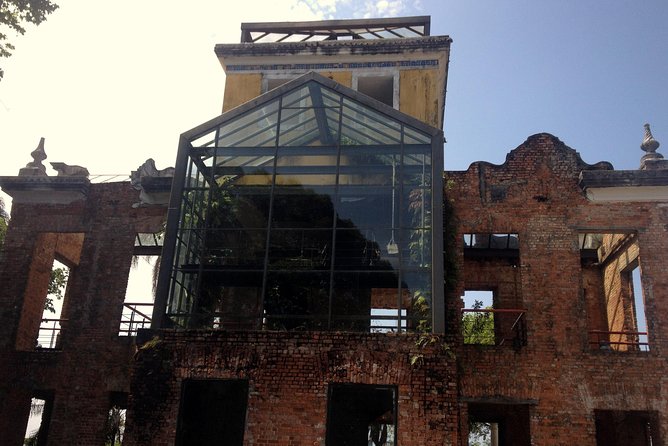
The next stop is Centro Cultural Municipal Parque das Ruínas, a former home associated with Laurinda Santos Lobo. The old residence has been transformed into a lookout and cultural space, and the tour allows about 30 minutes here.
This is one of the strongest stops for photographs. From the site, you can look toward central Rio, the Lapa Arches, Christ the Redeemer, and Botafogo. It is a useful moment to understand how Santa Teresa sits above the city and why the district has long attracted artists and people looking for a quieter hilltop setting.
The ruined structure is part of the appeal. You are not simply looking at a polished platform with a city view. The remains of the old house give the stop a sense of place, and the open outlook helps you connect the neighborhood to the larger city below.
Keep your expectations practical. The stop lasts only half an hour, so your guide will likely balance photographs, orientation, and background rather than offer a long museum visit. If views matter most to you, this is a highlight. If you want a formal indoor cultural program, the visit may feel brief.
More samba and nights in Lapa:
- Rio de Janeiro: Beginner Samba Lesson in Ipanema
★ 4.9 · 1,071 reviews - Rio: Pub Crawl in Lapa with Cachaça Tasting and Live Samba
★ 4.7 · 881 reviews - Rio: Carnival Backstage Tour at Samba City with Cocktail
★ 4.6 · 520 reviews - Hop-ON Hop-OFF Sightseeing Bus in Rio de Janeiro – Rio Samba Bus
★ 3.5 · 457 reviews
Selarón Steps, Rio’s tiled public artwork
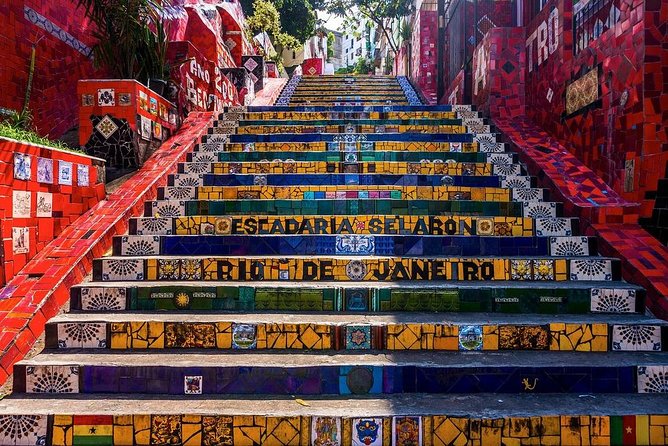
Leaving Santa Teresa, the route descends to Lapa and stops at the Escadaria Selarón, or Selarón Steps. You have about 30 minutes to see the famous staircase created by Chilean artist Jorge Selarón over roughly two decades.
The steps are covered in colorful tiles and are easy to appreciate even if you know nothing about the artist beforehand. Your guide can provide the story and point out details while you take time for photographs. This is a good example of Rio’s public art being part of daily streets rather than confined to a gallery.
I would not rush this stop. The staircase is visually busy, and a quick look from the bottom does not show how much detail is packed into the climb. Your guide may structure the visit around the most interesting sections, but the supplied information does not promise a full climb or a private viewing area.
Selarón Steps are also one of the places where the tour’s walking format pays off. You reach them as part of a connected route from the hills into Lapa, rather than treating them as an isolated photo stop reached by car.
Lapa Arches and the old aqueduct
The walk continues through Lapa, with graffiti-covered walls along the way. After Santa Teresa’s older houses and hilltop calm, this section feels more urban and energetic.
The Arcos da Lapa are the major landmark here. The structure began as an 18th-century aqueduct that carried water into Rio until the end of the 19th century. The Santa Teresa tram now passes over the arches on its route into the neighborhood, linking the opening ride with the history lesson at the end of the walking portion.
I like that the guide explains the arches as working infrastructure, not just as a famous backdrop. The structure tells you something about how Rio grew and how water once reached the city. You also get a chance to see how historic construction, graffiti, and modern city life share the same streets.
The stop itself is scheduled for about 20 minutes, so it is more of an orientation and photo visit than a long architectural study. If you want extensive detail about Rio’s colonial engineering, this tour will only give you an introduction.
Cinelândia and central Rio’s grand buildings
The final sightseeing stop is Cinelândia, a major square in central Rio. Here the guide points out the Teatro Municipal, the Museu das Belas Artes, the Câmara Municipal, the Biblioteca Nacional, and the Teatro Odeon.
This short 20-minute presentation helps broaden the tour beyond Santa Teresa and Lapa. The Teatro Municipal is Rio’s opera house, and the surrounding public buildings give the square a formal, civic character. The Teatro Odeon is noted as the only cinema in the square still operating, adding a small piece of modern life to the architectural setting.
You should think of Cinelândia as a guided introduction rather than a series of interior visits. The tour description does not include admission to these buildings, and the schedule does not leave time for extended museum or theater visits. If you have only a short stay in Rio, the stop gives you a useful map of central attractions to revisit on your own.
The tour then ends back at the stated meeting point. Since the route covers several districts and uses public transport, allow some flexibility after the scheduled finish if you have a tight afternoon booking.
Guides who shape the experience
The guide may make a bigger difference here than on a standard monument tour. Santa Teresa is best understood through its people, side streets, creative community, and neighborhood connections, and the tour provider assigns local guides rather than presenting a fixed scripted host.
Edmundo has been praised for making the area feel welcoming and for knowing people throughout Santa Teresa. His own work as an artist gives him a natural connection to the district’s creative side.
Lorena has a reputation for clear explanations, humor, and flexibility. She has adjusted plans when the tram was temporarily unavailable and changed the route when a participant had already seen one attraction. That sort of response matters on a neighborhood tour, where repeating a familiar stop can make the morning feel less personal.
Ivan is especially appealing if you want someone with a direct connection to the area. He is a Santa Teresa native and can explain the district from the perspective of someone who lives there. One past route also included a local art boutique, but that should not be treated as a guaranteed stop.
When you book, you cannot assume a particular guide unless the provider confirms it. If you have a strong preference for Edmundo, Lorena, or Ivan, ask in advance, but keep in mind that availability and scheduling can change.
What the $72.09 price covers
At $72.09 per person, this is not the cheapest way to see the Selarón Steps or the Lapa Arches. Those landmarks are free to view, and you could reach parts of the route independently using public transport.
The value comes from the combination. You are paying for a three-and-a-half-hour route, a small group capped at 12, guide service, neighborhood context, and the coordination of the tram and walking sections. If metro and tram tickets are included for your departure, that improves the package, but confirm exactly what is covered.
I think the price makes the most sense for a first visit to Rio, especially if you want help with public transport and a local explanation of Santa Teresa. It is less compelling for a repeat visitor who already knows the districts, speaks Portuguese comfortably, and prefers to set an independent pace.
The tour is also useful if you want a structured morning without committing to a full-day excursion. You see several important sites, but you still have the afternoon free for the beach, a museum, or another part of the city.
Walking demands, group size, and timing
The tour is listed as suitable for most people and operates with no more than 12 participants. That is small enough for a conversational pace and easier questions, though it is still a group walk rather than a private tour.
You will ride public transport, stand or sit during the tram portion, and walk through Santa Teresa and Lapa. The route moves from the hilltop neighborhood down toward central Rio, but the schedule does not specify the total walking distance or the number of steps at Selarón Steps.
Wear shoes you can use comfortably for three and a half hours. Bring water, sun protection, and a phone or camera for the views and tile work. These are practical suggestions for the walking format, not promises about amenities provided by the operator.
The 9 a.m. start is well chosen. You get the neighborhood before the day grows long, and you finish with time left for other plans. The tour is booked, on average, 21 days ahead, so it is sensible to reserve before your Rio dates fill up.
Who should book this Rio walking tour?
I would recommend it to a first-time Rio visitor who wants more than beaches and postcard viewpoints. It suits you if you like public art, old architecture, city stories, and a guide who can adjust the route to your interests.
It is also a strong choice for anyone curious about Santa Teresa but unsure how to combine it with Lapa. The tram ride, Parque das Ruínas, Selarón Steps, and Cinelândia create a clear half-day introduction.
You may want another option if you dislike walking, need a strictly timed finish, or want extensive interior visits at museums and theaters. The non-refundable policy is another serious consideration. Since the activity cannot be changed or refunded for any reason, book only when your plans are firm.
FAQ
Where does the tour start?
The stated meeting point is the Copacabana Palace, A Belmond Hotel, at Avenida Atlântica, 1702, in Copacabana, Rio de Janeiro. The start time is 9 a.m.
Where does the tour end?
The activity is listed as ending back at the meeting point.
How long does the experience last?
The tour lasts approximately 3 hours and 30 minutes.
How large is the group?
The maximum group size is 12 participants.
Is the Bonde tram ride included?
The itinerary includes admission for the Santa Teresa tram ride. Some outings have also included metro and tram tickets, so confirm the exact inclusions for your booking.
What neighborhoods does the tour visit?
The route explores Santa Teresa and Lapa, then continues to Cinelândia in central Rio.
Which major sights are included?
The stops include Largo dos Guimarães, Parque das Ruínas, Selarón Steps, the Arcos da Lapa, and Cinelândia, along with the Santa Teresa tram station.
Is the tour suitable for most people?
The activity information says most participants can take part and that it is near public transportation. The route includes public transport and walking, but no total distance or accessibility details are provided.
Can I cancel or change the booking?
No. The experience is non-refundable and cannot be changed for any reason. If the provider cancels because the minimum number of participants is not reached, you can choose another date or experience, or receive a full refund.
Should you book it?
Book this tour if you want a friendly, guided introduction to Rio’s hilltop artistic quarter and its historic center. The Bonde ride, Parque das Ruínas views, and Selarón Steps give the morning a strong visual rhythm, while guides such as Edmundo, Lorena, and Ivan can add the local detail that a self-guided route may miss.
Skip it if you want complete independence or if your schedule may change. For a firm itinerary and a first look at Santa Teresa and Lapa, the $72.09 price is reasonable for the transport, planning, small group, and personal guidance.
More Walking Tours in Rio
- Rio de Janeiro: Rocinha Favela Walking Tour with Local Guide
★ 4.8 · 3,052 reviews - Rio De Janeiro: Half-Day Rocinha Favela Walking Tour
★ 4.7 · 2,272 reviews - Sunrise and Sunrise Walk Two Brothers with Local Guide
★ 5.0 · 193 reviews - Rio de Janeiro: Little Africa Heritage Walking Tour
★ 4.9 · 177 reviews
Just added around Rio
- Rocinha Jeep Tour: A Journey into the Soul of the Favela!★ 3.8 · 3 reviews
- Tijuca National Park and all its wonders!★ 5.0 · 3 reviews
- Rio: Best Dive Experience All Inclusive Scuba Diving Package★ 5.0 · 3 reviews
- Rio de Janeiro: Doors-off 30-min helicopter tour★ 5.0 · 3 reviews
- Rio de Janeiro: Hang gliding adventure★ 3.7 · 3 reviews
- Pedra Bonita Trail: The easiest trail with a beautiful view of Rio★ 4.6 · 3 reviews
- Rio de Janeiro Secluded Beaches: Hike+Swim Prainha & Grumari★ 5.0 · 3 reviews
- Unforgettable Boat Party★ 5.0 · 3 reviews
Selarón Steps & Santa Teresa, compared.

Christ the Redeemer, Sugarloaf, Selaron & BBQ Lunch
Read our review →

Santa Teresa, Lapa, and Cinelândia with Tram Ride and Selarón Steps
Read our review →

Corcovado, Sugarloaf Mountain, and Selarón Steps 6-Hour Tour
Read our review →
Ancient Rio and Santa Teresa Tour with Hotel pick-up and drop-off
Read our review →
Christ the Redeemer & Selarón Steps Half-Day Tour
Read our review →
Christ the Redeemer and Escadaria Selarón Half-Day Tour
Read our review →Browse the lists this tour appears in