
Reviewed · SELARóN STEPS & SANTA TERESA
Centro Historico and Lapa – Santa Teresa Walking, Historical and Bohemian Tour
Rio’s old center, Santa Teresa’s hillside streets, and Lapa’s famous arches make a fine three-part story about Rio. This 7 to 8 hour route links grand civic buildings, baroque churches, street art, a yellow tram ride, and broad views without leaving you to piece the city together on your own.
I like the range of the day, especially the way it moves from the formal heart of Centro to the artistic corners of Santa Teresa. I also like the small group limit of 12 people, plus guide Ivan’s clear, personal storytelling about his city. The main drawback is the pace: you will walk for hours, climb through hillside neighborhoods, and need to buy your own lunch.
In This Review
- Key points at a glance
- Why this Rio walking tour works
- Cinelandia begins with Rio’s grand public face
- Cathedral glass and the baroque churches of Largo da Carioca
- Confeitaria Colombo and the old pedestrian streets
- Praça Quinze connects churches, palaces, and Guanabara Bay
- Candelária, Olympic Boulevard, and Praça Pio X
- Sao Bento Monastery is a serious highlight
- Mauá Square puts Rio’s cultural renewal on view
- Kobra’s Etnias mural brings in modern Rio
- The yellow tram climbs into Santa Teresa
- Largo dos Guimarães shows Santa Teresa’s bohemian side
- Parque das Ruinas gives you the day’s widest view
- Selarón Steps and the descent to Lapa
- Arcos da Lapa closes the circle
- What the $137.80 price includes
- Who should book it
- Should you book this Rio tour?
- FAQ
- Where does the tour start and finish?
- How long does the tour last?
- How many people can join?
- Is lunch included?
- What drink is included?
- Is the tram ride included?
Key points at a glance
- Fourteen stops across three districts: See Centro Histórico, Santa Teresa, and Lapa in one carefully packed day.
- A ride on the famous yellow Bonde: The tram takes you uphill toward Santa Teresa and provides a 30-minute panoramic journey.
- Major churches are part of the route: Enter the Metropolitan Cathedral, Sao Bento Monastery, and the churches near Largo da Carioca.
- Strong views without extra admission: Parque das Ruinas offers sights toward Centro, Lapa’s arches, Christ, and Botafogo.
- Street art with a Rio connection: Eduardo Kobra’s Etnias mural was made for the Olympic Games and represents five ethnic groups.
- One drink is included: You can choose a caipirinha, beer, soda, fruit juice, or water, but lunch costs extra.
Why this Rio walking tour works
The clever idea here is the connection between places. You are not simply ticking off churches and squares. You begin among Rio’s grand public buildings, follow old pedestrian streets toward Guanabara Bay, then take the tram into Santa Teresa before walking down to Lapa.
That gives you three different views of the city in one day. Centro shows Rio as a seat of government, religion, commerce, and culture. Santa Teresa feels more residential and artistic, with old houses, bars, restaurants, and hills. Lapa brings the route back to one of Rio’s best-known public spaces, where the old aqueduct now frames the neighborhood.
Guide Ivan is named as the person leading the experience. A good guide matters on a route like this because many of the buildings are best understood through their past uses and connections. The tour is available in a small group of no more than 12, a useful middle ground. You get more structure than wandering alone, but the group should remain small enough for explanations at churches and viewpoints.
The starting point is the Copacabana Palace at 9:00 am. The tour ends back at the same meeting point, so you do not have to work out a separate return journey after a long day on foot. Public transportation is nearby, and the tram segment is included.
More of Santa Teresa and the Selaron Steps:
- Rio: Christ the Redeemer, Sugarloaf, Selaron & BBQ Lunch
★ 4.5 · 2,428 reviews - Rio de Janeiro: Christ, Selaron Steps, and Tijuca Park Tour
★ 4.7 · 857 reviews - Santa Teresa, Lapa, and Cinelândia with Tram Ride and Selarón Steps
★ 4.5 · 274 reviews
Cinelandia begins with Rio’s grand public face
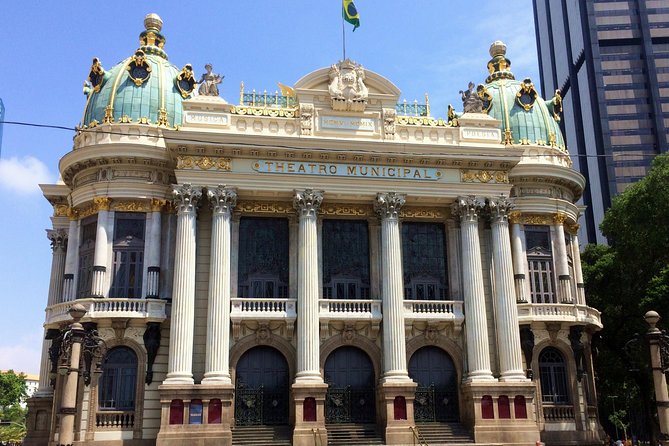
The first stop, Cinelandia, introduces you to the formal side of downtown Rio. In about 20 minutes, you see the Teatro Municipal, Rio’s opera house, the Museu das Bellas Artes, the Câmara Municipal, the Biblioteca Nacional, and the Teatro Odeon.
This is a good opening because the square gathers several major institutions in one place. You can look across the space and see how Rio presented itself as a modern cultural capital. The Teatro Odeon is especially easy to spot as the only cinema in the square still operating.
The stop is brief, so expect an overview rather than time inside every building. Admission is free here, but the tour does not include visits to the museums or opera house.
Cathedral glass and the baroque churches of Largo da Carioca
The Metropolitan Cathedral of Saint Sebastian is a sharp change from the formal European style of Cinelandia. Its huge modern structure and monumental stained-glass windows create one of the route’s most memorable interiors. You spend about 15 minutes inside, hearing about the cathedral’s architecture and history.
The short visit makes sense for a full-day route, but you should not expect a long quiet pause. The point is to understand the building and see the windows before moving on.
At Largo da Carioca, the focus shifts to older religious buildings. The tour passes the Church of Santo Antônio and the Church of Sao Francisco da Penitencia, described as one of Brazil’s finest baroque churches. A terrace beside these churches provides a panoramic view.
This is one of the stronger sections for anyone interested in architecture. You see a modern cathedral earlier in the morning, then ornate colonial-era church design soon afterward. Admission to the Largo da Carioca portion is included, and the stop lasts about 25 minutes.
Confeitaria Colombo and the old pedestrian streets
The walk through the old pedestrian streets leads to Confeitaria Colombo, one of Rio’s oldest cafés. The visit is short, around 10 minutes, with attention on its art deco style and its place in Centro.
You should think of this as a look rather than a full café stop. The schedule does not promise a meal or a seated break here. If you want to eat or order something, ask the guide how much time is available, since lunch is not included and the day continues for several more hours.
Still, this brief pause helps explain the character of central Rio. The route is not limited to huge landmarks. It also points out the interiors and meeting places that gave the old center its social life.
More samba and nights in Lapa:
- Rio de Janeiro: Beginner Samba Lesson in Ipanema
★ 4.9 · 1,071 reviews - Rio: Pub Crawl in Lapa with Cachaça Tasting and Live Samba
★ 4.7 · 881 reviews - Rio: Carnival Backstage Tour at Samba City with Cocktail
★ 4.6 · 520 reviews - Hop-ON Hop-OFF Sightseeing Bus in Rio de Janeiro – Rio Samba Bus
★ 3.5 · 457 reviews
Praça Quinze connects churches, palaces, and Guanabara Bay
At Praça Quinze de Novembro, the tour covers several landmarks in about 20 minutes. You see the Church of Our Lady of the Carmelites, the Paço Imperial, the equestrian statue of General Osório, Tax Island, and the ferry pier for Niterói and Paquetá Island.
The square is useful for understanding Rio’s position around Guanabara Bay. The ferry connections also give you a sense of how the city relates to the water and nearby communities. You are not taking a ferry on this tour, but the pier helps place the city geographically.
The Paço Imperial adds a political layer to the stop, while the church keeps the focus on religion and colonial-era architecture. Because there are several sights in a small area, Ivan’s explanations will help you know where to look instead of treating the square as just another open space.
Candelária, Olympic Boulevard, and Praça Pio X
The route continues along pedestrian streets to Praça Pio X. Here you see the Church of Candelária, the Olympic Boulevard, the Centro Cultural do Banco do Brasil, and Casa França Brasil.
This section shows how old Rio has been adapted for modern public life. The church belongs to the city’s older architectural story, while Olympic Boulevard represents a newer cultural and public corridor. The cultural centers add another reason to return to Centro if you have more time after the tour.
The stop lasts about 15 minutes and does not include entry to the cultural institutions. That is worth noting if you hoped to visit exhibitions. The tour gives you orientation and exterior views, not a museum program.
Sao Bento Monastery is a serious highlight
Sao Bento Monastery receives another 15-minute visit, including entry to the church and an explanation of its past. It is described as one of Rio’s most beautiful churches, and this is one of the places where the tour’s historical focus pays off.
The monastery offers a different mood from the open squares and street art that come later. You get a focused look at one important religious site before returning to the city’s public spaces. If ornate church interiors matter to you, this stop is a good reason to choose the tour.
As with the cathedral, the visit is fairly short. You will see the main interior and hear its story, but you will not have a long period for independent study.
Mauá Square puts Rio’s cultural renewal on view
Mauá Square is a major cultural stop near the water. The route presents the Museum of Tomorrow, which you do not visit, and the Art Museum of Rio, whose upper terrace offers views over the square, the Niterói Bridge, and the Museum of Tomorrow.
This is a valuable distinction: you see the buildings and the view, but museum admission is not part of the plan. The Art Museum of Rio’s terrace is the main visual reward here. It gives you a chance to look back at the area from above and understand how the square, museums, and bay fit together.
The stop lasts about 20 minutes. If the Museum of Tomorrow is a priority, you will need to return on another visit with more time. The same applies to the Art Museum of Rio if you want to see its exhibitions.
Kobra’s Etnias mural brings in modern Rio
The Etnias mural is one of the route’s most distinctive stops. Created by Eduardo Kobra for the Olympic Games, it represents five ethnic groups and is considered the largest mural in the world.
You spend around 15 minutes here. That is enough for a close look and photographs, though the tour treats it as one part of a much larger day rather than a full street-art walk. The mural also makes a useful bridge between the formal cultural buildings earlier in the route and the artistic identity of Santa Teresa and Lapa later on.
I like this inclusion because it keeps the tour from becoming a parade of churches and government buildings. Rio’s public art is part of the city’s story too.
The yellow tram climbs into Santa Teresa
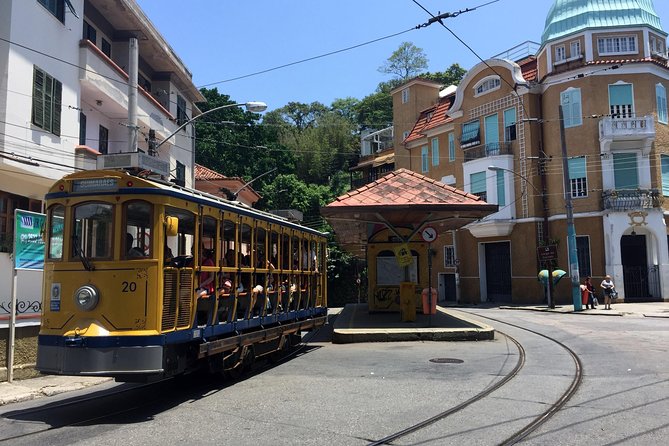
From the mural, you return to the Santa Teresa tram station and board the famous yellow Bonde. The ride uphill takes about 30 minutes and is listed as a 45-minute stop, allowing time around the station and the ride itself.
This is the tour’s most characterful change of pace. After hours through Centro, you leave the flat downtown streets and head into Santa Teresa by historic tram. The journey is described as panoramic and charming, with views along the route.
The tram ride is included in the price. It is also one of the reasons this experience offers more than a standard walking tour. You get a clear sense of the city’s hills without turning the entire day into a strenuous climb.
Even so, do not mistake the tram for a rest of the day. You continue walking once you reach Santa Teresa, and the route eventually descends toward Lapa.
Largo dos Guimarães shows Santa Teresa’s bohemian side
Largo dos Guimarães is the heart of Santa Teresa’s local scene. The tour allows about 45 minutes to walk around the area and see late 19th and early 20th-century houses, views, restaurants, and bars.
This is where the tour earns its bohemian description. The area is not presented as a single monument. Instead, you get a feel for the neighborhood’s streets, older homes, and places to stop for food or a drink.
Because lunch is not included, this area may be the most natural place to ask about a meal, though the supplied schedule does not promise a dedicated lunch break or a particular restaurant. Bring that question to Ivan early in the day so you can judge your time.
Parque das Ruinas gives you the day’s widest view
The Centro Cultural Municipal Parque das Ruinas is a former home of Laurinda Santos Lobo, now used as a viewpoint and cultural space. You spend about 30 minutes here.
The view reaches toward Centro, the Arcos da Lapa, Christ, and Botafogo. This is a strong payoff after the tram ride and neighborhood walk because it lets you see several parts of Rio from above. The viewpoint also makes the city feel connected: the downtown buildings you saw in the morning are now part of a broad panorama.
The stop is free. You should keep in mind that open viewpoints depend on visibility, so the exact quality of the panorama can vary with conditions. The tour still has value here because the site itself links Santa Teresa’s cultural past with its present use as a public lookout.
Selarón Steps and the descent to Lapa
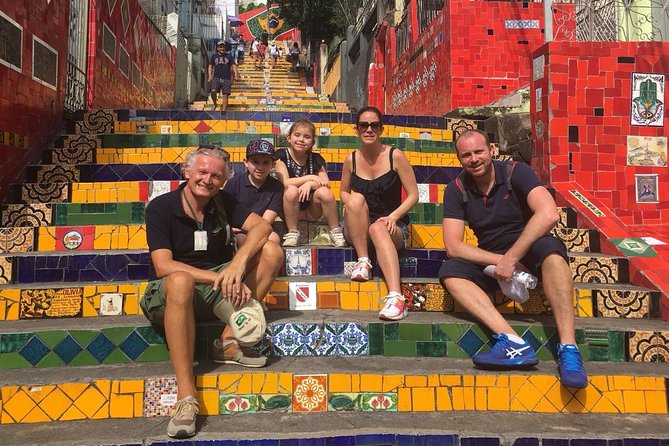
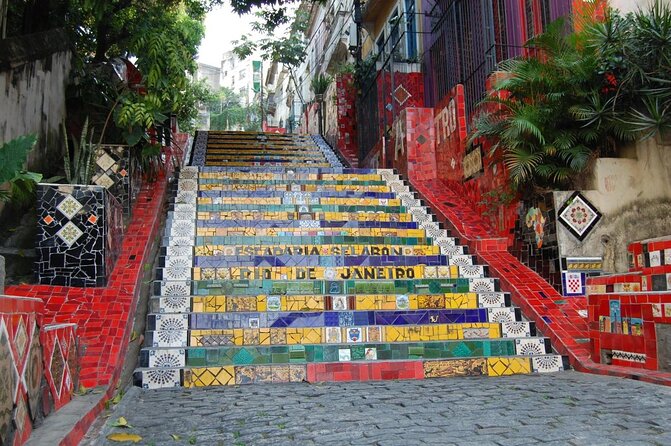
Leaving Santa Teresa, the route heads down toward Lapa and stops at the Escadaria Selarón. Chilean artist Jorge Selarón worked on the multicolored staircase for roughly 20 years.
You get about 30 minutes to see the steps. The long creation period is part of what makes the place more than a photo stop. It reflects the personal, hand-built side of Rio’s public art, in contrast to the large-scale Olympic mural seen earlier.
The stairs can be busy with people taking pictures, and the stop is visual rather than historical in the museum sense. Keep your attention on the guide while also allowing enough time to look closely at the tiles and colors.
Arcos da Lapa closes the circle
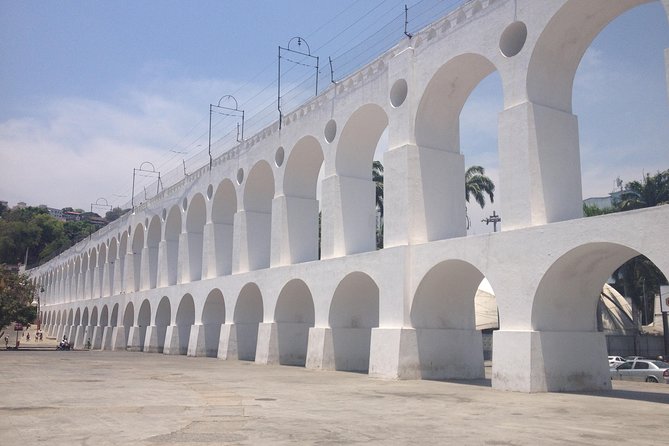
The final major stop is the Arcos da Lapa, an 18th-century aqueduct that supplied water to Rio until the end of the 19th century. The yellow tram now passes along the aqueduct as it travels to Santa Teresa, so seeing the arches after taking the tram gives the structure extra meaning.
The route reaches the arches through Lapa’s streets, with time to notice the graffiti on the walls. The stop lasts about 20 minutes. It is a fitting end because it joins old infrastructure, public art, and the tram route in one place.
The aqueduct is not just a famous backdrop. It explains part of how the city developed, while the graffiti shows how the same area continues to change. Afterward, you return to the original meeting point.
What the $137.80 price includes
At $137.80 per person, this is not a bargain-priced city stroll. The value depends on how much you want handled in one day.
The price includes the guided route, entry where specified, the yellow tram ride, and one drink. You can choose a caipirinha, beer, soda, fruit juice, or water. Lunch is not included, so set aside extra money for food.
You are paying for a long route across three districts, transport between the flat center and hillside Santa Teresa, and a guide who connects the stops. If you tried to arrange the same sequence independently, you would need to plan the walking route, tram segment, church visits, viewpoints, and return to Copacabana.
The price makes the most sense for a first visit when you want a full orientation of central Rio. It is less appealing if you prefer slow museum visits, long café stops, or exploring one neighborhood at a time.
Who should book it
I would choose this for you if you want history, architecture, street art, and city views in one organized day. It suits active visitors who can handle several hours of walking and want to see more than Copacabana, Ipanema, and the beach districts.
It is also a good fit if you prefer a small group. A maximum of 12 people is more manageable than a large coach outing, especially in churches, pedestrian streets, and viewpoints.
You may want another plan if lunch breaks, museum interiors, or an unhurried pace are central to your trip. The itinerary has many stops, and most visits last between 15 and 30 minutes. You see a lot, but you will not linger everywhere.
The experience requires a minimum number of bookings to operate. If that minimum is not met, a different date or experience, or a full refund, is offered. The booking itself is non-refundable and cannot be changed for any reason, so make sure your schedule is firm before paying.
Should you book this Rio tour?
Book it if you want the broadest possible introduction to Centro, Santa Teresa, and Lapa in one day, and if Ivan’s storytelling and the included tram ride appeal to you. The combination of Sao Bento, the cathedral, Kobra’s mural, Parque das Ruinas, Selarón Steps, and the Arcos da Lapa gives you a strong mix of old and new Rio.
Skip it if you want a relaxed day with long museum visits or a carefully planned lunch. At $137.80, the tour earns its price through coverage and guidance, not through leisure time. For an active first look at Rio beyond the beaches, it is a well-filled choice.
FAQ
Where does the tour start and finish?
It starts at 9:00 am at the Copacabana Palace, A Belmond Hotel, at Av. Atlântica, 1702, Copacabana. The activity ends back at the same meeting point.
How long does the tour last?
The tour lasts approximately 7 to 8 hours.
How many people can join?
The group has a maximum of 12 participants.
Is lunch included?
No. Lunch is not included in the tour price.
What drink is included?
You can choose one caipirinha, beer, soda, fruit juice, or water during the tour.
Is the tram ride included?
Yes. The ride on the Santa Teresa yellow Bonde is included.
More History Walks in Rio
- Rio de Janeiro: Historic Rio and Santa Teresa Half-Day Tour
★ 4.4 · 228 reviews - Explore Little Africa : Unveiling Afro Heritage in Rio de Janeiro
★ 5.0 · 97 reviews - Learn the History of Rio with an Unforgettable City Center Walking Tour
★ 5.0 · 82 reviews - Rio’s city walking tour: a glimpse of history and olympic legacy
★ 4.5 · 78 reviews
More Walking Tours in Rio
- Rio de Janeiro: Rocinha Favela Walking Tour with Local Guide
★ 4.8 · 3,052 reviews - Rio De Janeiro: Half-Day Rocinha Favela Walking Tour
★ 4.7 · 2,272 reviews - Sunrise and Sunrise Walk Two Brothers with Local Guide
★ 5.0 · 193 reviews - Rio de Janeiro: Little Africa Heritage Walking Tour
★ 4.9 · 177 reviews
Just added around Rio
- Rocinha Jeep Tour: A Journey into the Soul of the Favela!★ 3.8 · 3 reviews
- Tijuca National Park and all its wonders!★ 5.0 · 3 reviews
- Rio de Janeiro: Doors-off 30-min helicopter tour★ 5.0 · 3 reviews
- Rio de Janeiro: Hang gliding adventure★ 3.7 · 3 reviews
- Rio: Best Dive Experience All Inclusive Scuba Diving Package★ 5.0 · 3 reviews
- Pedra Bonita Trail: The easiest trail with a beautiful view of Rio★ 4.6 · 3 reviews
- Rio de Janeiro Secluded Beaches: Hike+Swim Prainha & Grumari★ 5.0 · 3 reviews
- Unforgettable Boat Party★ 5.0 · 3 reviews
Selarón Steps & Santa Teresa, compared.

Christ the Redeemer, Sugarloaf, Selaron & BBQ Lunch
Read our review →

Santa Teresa, Lapa, and Cinelândia with Tram Ride and Selarón Steps
Read our review →

Corcovado, Sugarloaf Mountain, and Selarón Steps 6-Hour Tour
Read our review →
Ancient Rio and Santa Teresa Tour with Hotel pick-up and drop-off
Read our review →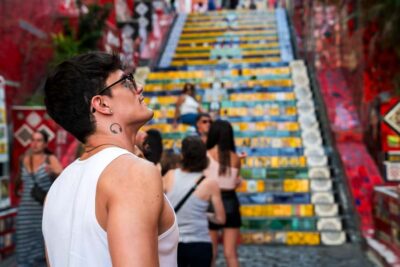
Christ the Redeemer & Selarón Steps Half-Day Tour
Read our review →
Christ the Redeemer and Escadaria Selarón Half-Day Tour
Read our review →Browse the lists this tour appears in